Interior Ballistic Modeling – Computational Approach
Case pressure (p0) as a function of time is given by the following equation. Since it is a differential equation, the computation must be done iteratively.
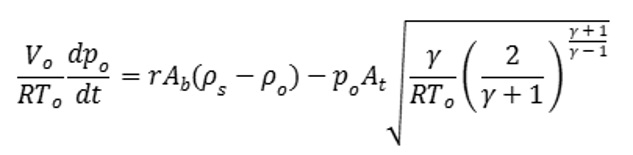
This equation is general and accurately accounts for both transient phases, i.e., case pressurization upon ignition and blowdown after burnout as well as the so-called steady state. Steady state refers to the phase of the burn where the case is fully pressurized and does not change that much until burnout. In this phase, dP/d~0 and the equation reduces to the closed form:
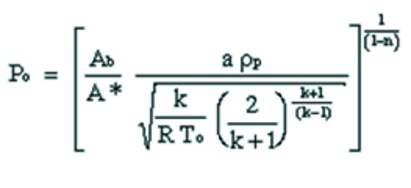
To solve either equation it is necessary to know the grain surface area as a function of time. The burn front is assumed to progresses normal to the grain surface, St. Robert’s law computes the burn rate and therefore the burn front progression as a function of time.
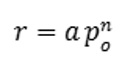
This must be translated into grain surface area as a function of time. Grain surface area depends on the grain geometry. Computing surface area as a function of time is straightforward for simple geometries (like Bates grains for example). However, it becomes increasingly difficult for even symmetric but moderately complex grain geometries. In fact, the only computationally difficult aspect of interior ballistics is determining the surface area versus burn progression curve for the grain(s) in question. Once that is known, computing the P/t curve is easy.
Once the P/t curve is determined, the F/t or thrust curve can be determined. It can be computed from the equation below. A good reference is the thrust equations available at the NASA Glenn Research Center website and Richard Nakka’s website. For any case pressure, the thrust (F) is given by:

Where p0 is the case pressure, pe is the pressure at the exit cone, and pa is atmospheric pressure (k is gamma). Several commercial programs are available capable of rocket motor interior ballistics. These include SPP, BurnSim, OpenMotor and others. SPP is considered as the industry standard for rocket motor ballistics but is ridiculously difficult to learn. BurnSim, originally designed for amateur rocket applications, has come a long way and is a very useful tool especially for proposal work. BurnSim uses the steady state equation only so cannot account for ignition and blow down transients. However, these phases are often unimportant in the conceptual design phase and can usually be analyzed in the detail design phase post-award.
I wrote an interior ballistics program that I call MULTIPERF. It is designed to perform interior ballistics for crew-served missile applications, like STINGER and TOW for example. Tube-launched, crew-served missile launch motors must have short enough action times such that the propellant is entirely consumed while the missile is still in the launch tube. This is to prevent the crew being exposed to the exhaust plume. Sometimes the launch motor serves as the sole propulsion, as in SMAW and LAW. In larger missiles, a flight motor ignites when the missile is a safe distance from the crew. More on MULTIPERF in the next article.
Privacy Policy
Web site and all contents Copyright Explosives Consulting LLC. All rights reserved.


